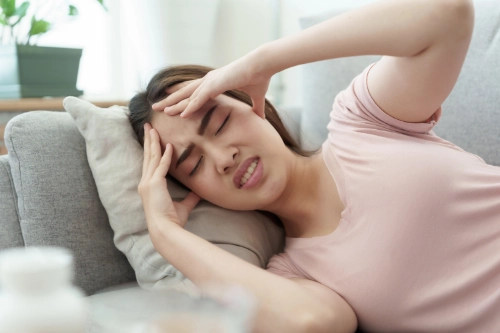
 Not every headache starts in your head. If your headaches tend to begin at the base of your skull, wrap around to one side, and worsen after a long day at a desk or a poor night’s sleep, the real source may be your neck. These are called cervicogenic headaches, and they’re one of the most common headache types that respond well to chiropractic care. Because the problem originates in the cervical spine rather than the brain itself, addressing the underlying joint dysfunction and muscle tension in the neck can bring lasting relief — often without relying on daily pain medication.
What Are Cervicogenic Headaches?
A cervicogenic headache is a secondary headache, meaning it’s caused by an underlying issue somewhere else in the body — in this case, the joints, discs, muscles, or nerves of the upper cervical spine. The upper three cervical vertebrae (C1–C3) share nerve pathways with the trigeminal nerve, which supplies sensation to the face and head. When those upper neck joints become restricted, irritated, or misaligned, the nervous system can misinterpret that irritation as head pain, a phenomenon known as “referred pain.”
This is different from a typical tension headache or migraine, even though the symptoms can overlap. Cervicogenic headaches are mechanical in nature — they stem from a physical problem in the neck — which is exactly why chiropractic treatment, which addresses joint mechanics directly, tends to be so effective for this particular headache type.
What Causes Cervicogenic Headaches?
Cervicogenic headaches typically develop from dysfunction in the cervical spine. Common contributing factors include:
- Forward head posture from prolonged phone, computer, or desk use, which places excess strain on the upper cervical joints
- Cervical spine misalignment or restricted joint motion, particularly in the upper three vertebrae
- Whiplash or prior neck trauma, even if it occurred years earlier
- Degenerative changes in the cervical discs or facet joints
- Chronic muscle tension in the suboccipital muscles at the base of the skull
- Poor sleep posture, such as sleeping on an unsupportive pillow or in a twisted neck position
- Prolonged stress, which tends to concentrate tension in the neck and shoulders
Because these headaches are rooted in mechanical dysfunction rather than a chemical or vascular process in the brain, they often don’t respond well to standard headache medications, and can persist for months or years without treatment addressing the neck itself.
Common Symptoms of Cervicogenic Headaches
Cervicogenic headaches have a fairly recognizable pattern that helps distinguish them from migraines or tension headaches:
- Pain that starts at the base of the skull or upper neck and radiates forward toward the forehead, temple, or behind one eye
- Headache that is typically one-sided, though it can occasionally be bilateral
- Neck stiffness or reduced range of motion accompanying the headache
- Pain that worsens with certain neck movements or sustained postures
- Tenderness when pressing on the upper neck or base of the skull
- Headache episodes that are triggered or worsened by long periods of sitting, screen use, or poor posture
- A dull, steady ache rather than the throbbing, pulsing quality often associated with migraines
Because cervicogenic headaches can mimic migraines or tension-type headaches, a proper evaluation of neck mobility and posture is often the key to an accurate diagnosis.
How Chiropractic Care Treats Cervicogenic Headaches
Chiropractic treatment for cervicogenic headaches focuses on restoring proper motion and reducing irritation in the cervical spine — the actual source of the problem, rather than simply masking the pain.
Cervical Spinal Adjustments
Gentle, specific adjustments to the upper cervical spine restore normal joint motion in the segments most commonly linked to referred head pain. Improving mobility in these joints reduces the irritation that triggers the referred pain pattern in the first place.
Soft Tissue Therapy
Techniques such as myofascial release, trigger point therapy, and instrument-assisted soft tissue mobilization (IASTM) target the suboccipital and upper trapezius muscles, which are frequently tight and overactive in people with cervicogenic headaches. Releasing this tension reduces the mechanical strain feeding into the referred pain pattern.
Postural Correction and Ergonomic Guidance
Since forward head posture is one of the leading contributors to cervicogenic headaches, chiropractors work with patients on postural retraining, along with practical adjustments to desk setup, screen height, and daily habits that reduce ongoing strain on the neck.
Corrective Exercises
Targeted strengthening exercises for the deep neck flexors and postural stabilizing muscles help support the cervical spine between visits, reducing the likelihood that dysfunction and referred pain will return.
Full Spinal Evaluation
Because the cervical spine doesn’t function in isolation, a chiropractor will typically also assess the thoracic spine and shoulder girdle, since restrictions or misalignments in these areas can contribute to the postural patterns that stress the neck.
Chiropractic Care vs. Medication and Other Interventions
Cervicogenic headaches are often treated first with over-the-counter or prescription pain relievers, muscle relaxants, or even nerve block injections targeting the occipital nerves. These approaches can provide temporary relief, but they don’t correct the underlying joint restriction or postural pattern driving the headaches — which means symptoms tend to return once the medication wears off.
Occipital nerve blocks and other injection-based treatments can be helpful in more severe or treatment-resistant cases, but for many patients, addressing the cervical spine mechanics directly resolves the problem at its source. Chiropractic care offers a drug-free option that treats the actual cause of the referred pain rather than simply interrupting the pain signal.
What to Expect During Recovery
Many patients notice a reduction in headache frequency and intensity within the first several visits, particularly once cervical joint mobility begins to improve. Full resolution typically depends on how long the postural and mechanical dysfunction has been present — patients with years of forward head posture or an old whiplash injury may need a longer course of care than those with a more recent onset.
A typical treatment plan combines in-office adjustments and soft tissue work with a home program of posture correction and neck-strengthening exercises, since long-term relief depends heavily on addressing the daily habits that originally contributed to the problem.
Stop Treating the Symptom and Start Treating the Source
If your headaches consistently start in your neck or the base of your skull, chasing relief with pain medication alone is unlikely to solve the underlying problem. Our team can evaluate your cervical spine and posture, identify what’s driving your headaches, and build a treatment plan aimed at the actual source — not just the symptom. Call our office today to schedule an evaluation and start getting ahead of your headaches instead of reacting to them.
Frequently Asked Questions
How do I know if my headache is coming from my neck?
Cervicogenic headaches typically start at the base of the skull or upper neck and radiate forward to one side of the head, often accompanied by neck stiffness, reduced range of motion, and tenderness when the upper neck is pressed. Headaches that worsen with certain neck movements or prolonged sitting are a strong indicator of a cervical origin.
Can a chiropractor tell the difference between a cervicogenic headache and a migraine?
Yes. A chiropractic evaluation typically includes an assessment of neck mobility, posture, and palpation of the cervical spine to identify mechanical dysfunction consistent with cervicogenic headaches, helping distinguish them from migraines or tension-type headaches that don’t originate in the neck.
Is it safe to get neck adjustments if I have frequent headaches?
Yes, for most patients. Chiropractors perform a thorough evaluation before treatment to confirm the headaches are mechanical in nature and that cervical adjustments are appropriate, using gentle, targeted techniques suited to the individual’s condition.
How many chiropractic visits does it take to relieve a cervicogenic headache?
Many patients notice improvement within the first several visits, though the full timeline depends on how long the underlying neck dysfunction has been present. Chronic, long-standing postural issues generally require a longer course of care than a recent onset.
Can poor posture from working at a computer really cause headaches?
Yes. Forward head posture from prolonged screen use places significant strain on the upper cervical spine, which is one of the most common contributors to cervicogenic headaches. Postural correction is often a key part of resolving them long-term.
Will my cervicogenic headaches come back after treatment?
They can if the underlying postural habits or joint dysfunction aren’t addressed. That’s why chiropractic treatment plans typically include corrective exercises and ergonomic guidance alongside in-office care, aiming to prevent the dysfunction from returning.
Can an old whiplash injury cause headaches years later?
Yes. Whiplash can leave lasting joint restriction and instability in the cervical spine that may not cause noticeable symptoms right away but can contribute to cervicogenic headaches months or even years after the original injury.